The short version
Priority seats are the one accessibility feature that depends entirely on strangers behaving well. For people whose disability is not visible, that makes them a daily negotiation — and sometimes a confrontation.
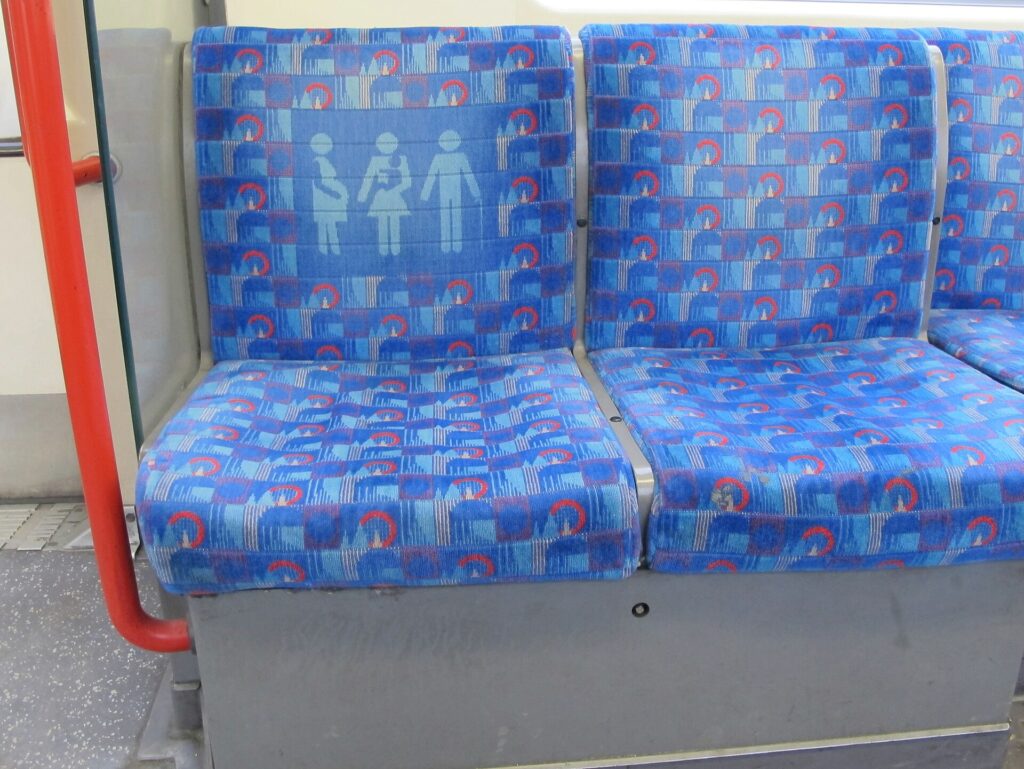
Every bus and train in Britain has priority seats, marked with a sign. They are the cheapest piece of accessibility infrastructure there is: no lift to maintain, no ramp to deploy, no budget line. And they are the least reliable, because they depend entirely on other passengers choosing to behave well.
If your disability is visible, that mostly works. If it is not, the priority seat becomes a negotiation you have to open, in public, with a stranger, while feeling unwell.
What priority seats actually are
Priority seats are for disabled passengers, older passengers, pregnant passengers and people who cannot stand safely. They are usually nearest the doors, with more legroom and grab rails.
They are not legally reserved in the way a wheelchair space is. Nobody is committing an offence by sitting in one. The system relies on signage, announcements and social pressure — which is exactly why it fails for people who do not look like the sign.
The daily arithmetic
People whose conditions are invisible describe the same calculation over and over. Ask, and risk being challenged, stared at, or told you look fine. Do not ask, and risk fainting, a fall, a pain flare, or a panic attack.
The conditions involved are common and serious: POTS and other forms of dysautonomia, where standing genuinely causes collapse; chronic pain and fatigue; heart and lung conditions; balance disorders; the after-effects of a stroke; epilepsy; pregnancy in the early months; anxiety and PTSD; recovery from surgery.
Being asked to justify yourself to a carriage full of strangers is not a small thing to add to someone’s commute.
Things that genuinely help
The Sunflower lanyard
The Hidden Disabilities Sunflower does a lot of this work silently. It signals that you have a non-visible disability without requiring you to say a word about it, and it is increasingly recognised on transport. It is free from most airports and many staffed stations.
“Please offer me a seat” badges
Transport for London issues a free “Please offer me a seat” badge and card, and several other operators run similar schemes. They are explicit, they are free, and no evidence of disability is required to get one. If your local operator does not offer one, ask them why not — it costs almost nothing.
Asking the staff, not the passengers
On a train, ask the conductor or platform staff to help you find a seat. On a bus, ask the driver to make an announcement. Handing the request to a member of staff removes the personal confrontation entirely, and it is their job.
If you are challenged
You do not owe anyone your medical history. Ever. Some responses that end it quickly:
- “I have a disability that you can’t see. I need this seat.”
- “Not all disabilities are visible.”
- “I’m not going to discuss my medical condition, but I do need to sit down.”
If someone becomes aggressive, involve staff and, if necessary, report it. On the railway, text British Transport Police on 61016. Harassing someone over a priority seat is not a difference of opinion; it can be a hate incident, and reporting it is how it gets recorded as one.
If you are the person in the seat
Most people occupying a priority seat are not being selfish. They simply have not looked up. A few things that make the whole system work better:
- Sit somewhere else first if you can, and keep priority seats free until the vehicle fills.
- Look up at each stop. Most requests never have to be made if someone notices first.
- If someone asks, just move. You are not owed an explanation, and asking for one is the thing that makes people dread asking.
- Assume the person asking has a good reason. They almost always do, and the cost of being wrong is that you stood up unnecessarily.
What operators should be doing
This is not purely a matter of manners. Operators can and should make the seats work:
- clear, high-contrast signage that mentions non-visible disabilities explicitly
- regular announcements asking passengers to offer priority seats — not just at the terminus
- free badge schemes, promoted properly
- staff trained to intervene so the passenger does not have to
- enough seats that the question arises less often
If your operator does none of that, it is a fair and specific thing to raise with them — and with the transport authority that funds them. Our complaints guide has the wording.