The short version
A green lanyard covered in sunflowers is now recognised across airports, railways and supermarkets as a discreet signal that someone has a non-visible disability. Here is how it works, what it does not do, and where to get one without paying.
If your disability is not visible, every journey involves the same tiring calculation: do I explain myself to this stranger, or do I struggle in silence? Explain, and you might be doubted. Stay quiet, and you get treated as though nothing is wrong — jostled in a queue you cannot stand in, hurried through a gate you need time at, spoken to too fast to follow.
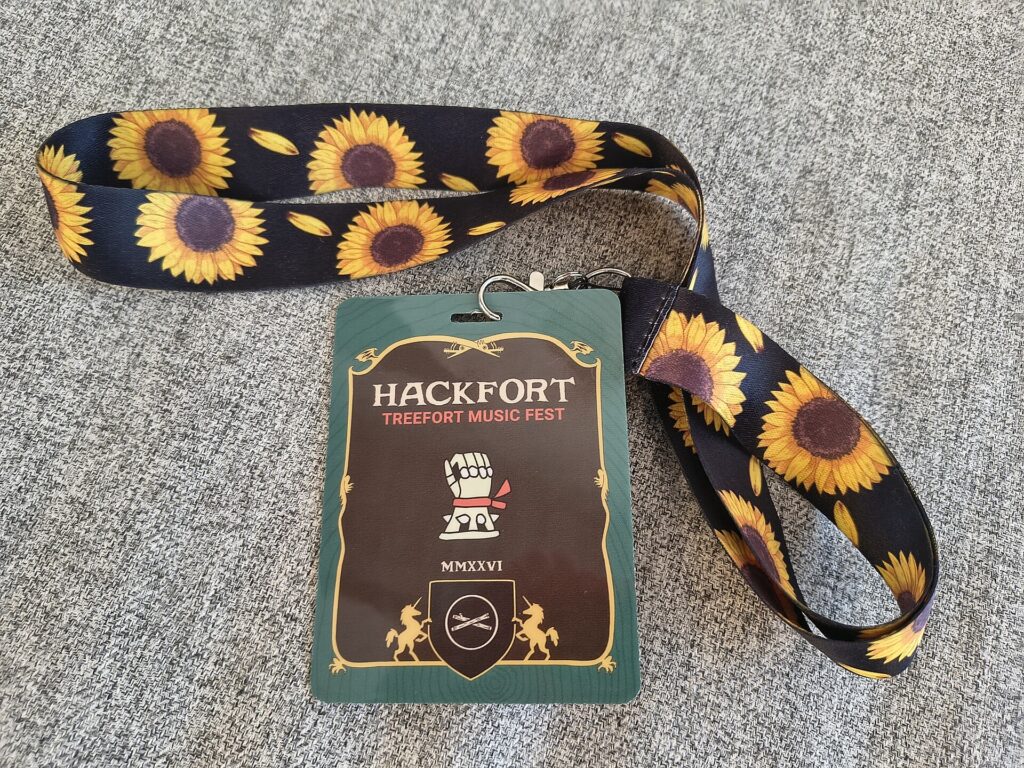
The Hidden Disabilities Sunflower exists to remove that calculation. It is a green lanyard patterned with yellow sunflowers, and it means one thing: I have a disability you cannot see, and I may need a little more time, help or patience.
Where it came from
The scheme began at Gatwick Airport in 2016. Staff wanted a way for passengers with non-visible disabilities to be recognised discreetly, without having to announce a diagnosis at every desk. It spread to other airports, then to railways, supermarkets, hospitals, stadiums, councils and banks — and to more than a dozen countries.
It works because it asks almost nothing of the wearer and very little of the staff. You put it on. Trained staff notice it and adjust: they slow down, they offer a seat, they explain twice, they let you use the assistance lane instead of the scrum.
Who it is for
Anyone with a disability or condition that is not immediately obvious. That is a deliberately wide door, and it includes:
- autism, ADHD and other neurodivergence
- chronic pain, fatigue, ME and long Covid
- anxiety, PTSD and other mental health conditions
- dementia and cognitive impairment
- deafness and partial hearing loss
- sight loss that is not obvious to a stranger
- epilepsy, diabetes, Crohn’s, colitis and stoma
- speech and language differences
- learning disabilities
- the after-effects of a stroke or brain injury
There is no list you have to appear on and no condition that is officially “enough”.
Where to get one — free
This is the part people most often get wrong: you should not have to pay. Lanyards are given out free at hundreds of places across the UK. Ask at a customer service desk, an assistance point, or a special assistance desk.
Airports
Most UK airports hand them out free, usually from the special assistance desk or an information desk in the terminal. Manchester is one of the largest participants, and you will also find them at airports including Heathrow, Gatwick, Birmingham, Bristol, Newcastle, Edinburgh, Glasgow, Stansted, Luton, East Midlands, Liverpool and Belfast.
You do not need to be flying that day at most airports — but ring ahead if you are making a special trip, because desk locations and opening hours vary.
Railway stations
Most staffed LNER stations will give you one free — that is the East Coast route, so King’s Cross, Peterborough, Grantham, Newark, Retford, Doncaster, Wakefield, Leeds, York, Northallerton, Darlington, Durham, Newcastle, Berwick and on into Scotland at Edinburgh, and stations towards Aberdeen and Inverness.
Other train operators run the scheme too, and availability keeps growing. Ask at the ticket office or the mobile assistance team.
Everywhere else
- Supermarkets — customer service desks at many Tesco, Sainsbury’s, Asda, Morrisons, Marks & Spencer, Waitrose and Co-op stores
- NHS trusts and hospitals, often via the PALS office
- Councils, libraries and civic buildings in many areas
- Stadiums, theatres and visitor attractions with an accessibility team
- Some banks, building societies and large retailers
The Hidden Disabilities Sunflower website keeps the definitive list of participating organisations, and also sells lanyards, cards and badges directly if you would rather not ask anyone. But do check locally first — free is free.
You should never be asked to prove anything to get a Sunflower lanyard. There is no test, no register, and no diagnosis to produce. That is the entire point of it.
What it does not do
Being clear about the limits matters, because misplaced expectations lead to bad days out.
- It is not proof of disability. It is not an ID card, a Blue Badge or a benefit award. Nobody is checking, and nobody should be.
- It does not entitle you to anything specific. It is not a queue-jump pass, a free ticket or a guaranteed seat. It signals a need; it does not create a right on its own.
- It only works where staff are trained. In an airport or a big station, recognition is high. On a rural bus at 10pm, it may mean nothing at all to the driver.
- It does not replace asking. If you need something specific, say so. The lanyard makes that conversation easier; it does not remove the need for it.
Your rights are separate — and stronger
Here is the crucial thing. The Sunflower is a courtesy scheme. Your legal protection comes from the Equality Act 2010, and it applies whether or not you are wearing anything at all.
Transport operators, shops and venues have a duty to make reasonable adjustments for disabled people. That duty does not switch on when you put a lanyard on and off when you take it off. If you are refused help, treated badly, or told you must prove your disability, that is potentially discrimination — and the lanyard is irrelevant to whether you have a claim.
So wear it if it helps. Do not feel obliged to. And never let anyone imply that you needed to be wearing one to deserve decent treatment.
Using it well
- Pick it up before the day you need it. Rummaging at a customer service desk while your train boards is not the moment.
- Consider the card as well as the lanyard. Many schemes offer a small card you can write on — “I lip-read”, “I need extra time”, “please speak slowly”. It saves the explanation entirely.
- Still book assistance if you need physical help. The lanyard is not a substitute for Passenger Assist.
- Say what you need. Staff who notice the lanyard usually ask “can I help?” — have your answer ready.
- Report it when it fails. If staff at a participating organisation ignore or challenge it, tell that organisation. Schemes only stay meaningful if the training behind them is kept up.
The bigger picture
A lanyard is a workaround. It exists because the default way we run transport and public space assumes a passenger who can stand, wait, hear, read quickly, cope with noise and explain themselves under pressure. Everyone who does not fit that template is left to signal their difference with a piece of ribbon.
That said — it works. It has spared a lot of people a lot of explaining, and it costs an organisation almost nothing to join. If somewhere you use regularly is not part of it, ask them why not. It is one of the cheapest access improvements available.