The short version
Half a million people in the UK live with IBD, and well over 100,000 with a stoma. For them, "customers only" and a judgemental look at the accessible loo can end a day out. The cards, keys and comebacks that keep the door open.
Some disabilities make the toilet the whole battlefield. Around half a million people in the UK live with inflammatory bowel disease — Crohn’s disease and ulcerative colitis — and well over a hundred thousand live with a stoma. Add bladder conditions, bowel surgery and pelvic disorders, and “where is the nearest toilet, and will they let me use it” is the constant background calculation of hundreds of thousands of days out.
Two things make it harder than it should be: gatekeeping (“customers only”, “the accessible toilet is for disabled people” — said to someone who is disabled), and facilities that were designed as if the only disability were a wheelchair.
The kit that opens doors
- The “Can’t Wait” card — issued by Crohn’s & Colitis UK — says, wallet-sized, that the holder has a medical condition and needs urgent toilet access. It carries no legal force, and it works remarkably often: it converts an argument into a nod. Similar cards exist from the Bladder & Bowel Community and stoma charities.
- The RADAR key (National Key Scheme) opens thousands of locked accessible toilets across the UK — a few pounds from Disability Rights UK or many councils. If urgency is part of your life, it lives on your keyring.
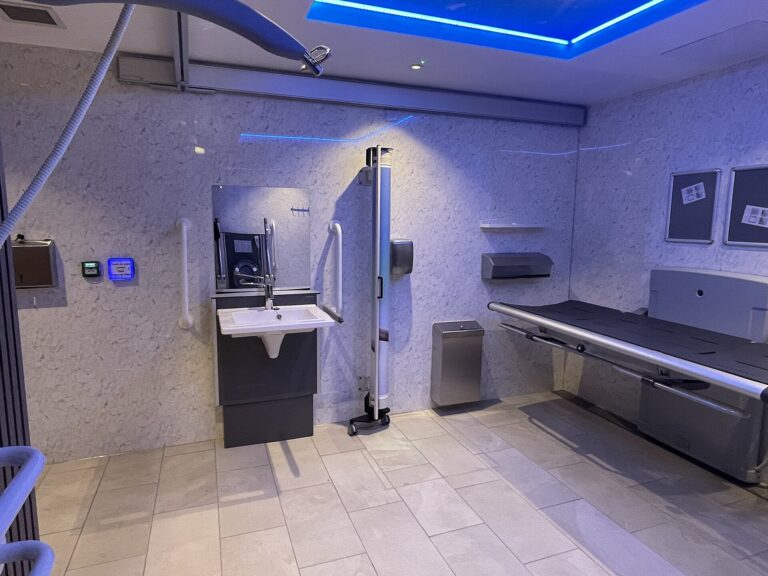
- Toilet-finder maps — including the National Key Scheme lists and community toilet scheme maps — reward five minutes of planning. Our own station map notes station toilet detail for many stations, and Changing Places facilities cover those who need more than a standard cubicle.
The accessible loo is for you
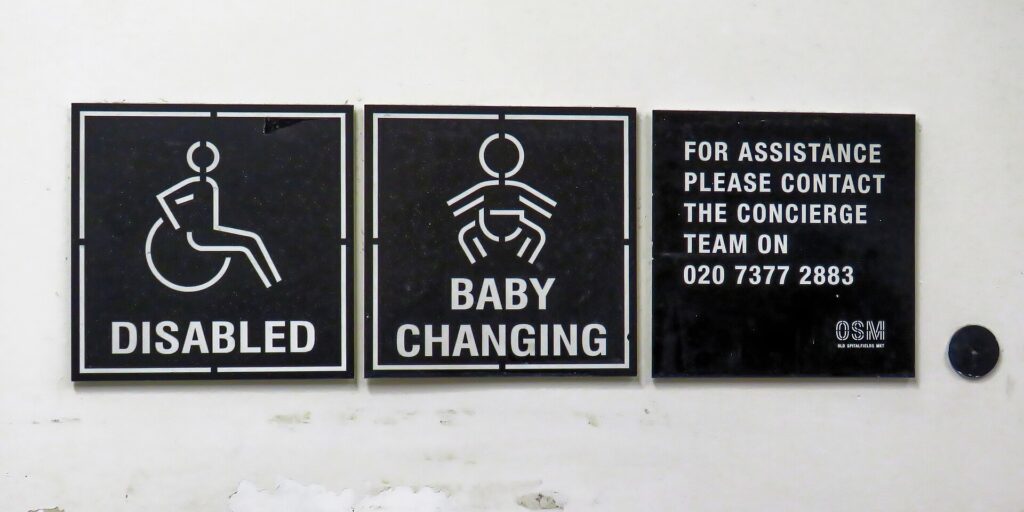
People with stomas and IBD get challenged at accessible toilets constantly — because they walked in. So, plainly: the accessible toilet is not the wheelchair toilet. You need the space, the sink beside you, the shelf, the bin and the time. That is what it is for. “Not every disability is visible” signs are spreading across supermarkets precisely because this challenge culture became indefensible.
What a genuinely stoma-friendly toilet needs — and what to ask venues for by name — is modest: a shelf at usable height, a hook, a mirror you can stand at, a decent bin in every cubicle (male cubicles routinely lack one), and soap and water actually within reach. A venue that will not add a £15 shelf after being asked in writing is telling you how much it wants your custom.
Nobody chooses the accessible cubicle for fun. If someone walks in and locks the door, the overwhelming likelihood is that they need it — and the correct response from everyone else is nothing.
What the law does and doesn’t give you
- There is no general legal right to use any business’s toilet — that is why the cards work on goodwill. But where a venue provides toilets for customers, refusing a disabled person urgent access, or blocking the accessible cubicle with stock (a classic), runs straight into the reasonable adjustments duty.
- IBD, stomas and bladder conditions are disabilities under the Act in almost all cases — long-term, substantial effect — whatever they look like from the outside.
- At work, adjustments include desk location, break flexibility and no quibbling about toilet time; Access to Work and Acas back this up.
- Public toilet provision itself is discretionary for councils — which is why so many closed. Community toilet schemes (councils paying cafés and shops to open their loos to everyone) are the practical replacement: ask your council if it runs one, and if not, why not — it is one of the cheapest access wins going.
Scripts that work
- At the counter, card in hand: “I have a medical condition and need the toilet urgently — here’s my card.” Say it while walking. Apologise to nobody.
- At a challenge: “Not every disability is visible. I need this toilet.” Full stop, no diagnosis owed.
- Refused, afterwards: write to the venue and head office — what happened, when, what it cost you — and pin it on our map. Our complaints guide has the template.
- And when a venue gets it right — the quiet nod, the unlocked door, the shelf — tell them that too. Gold pins exist on our map for a reason.