
The short version
Disabled people pay more to travel and earn less on average. These schemes cut the cost — including the ones nobody tells you about, like a companion travelling at a third off.
Disability costs money. Extra Costs research has consistently found disabled households spend hundreds of pounds a month more than non-disabled households for the same standard of living, and transport is a big part of that — taxis when the bus fails, a car when the train is impossible, a companion’s fare on top of your own.
None of the schemes below fix that. All of them help, and the take-up on several is far lower than it should be simply because nobody mentions them.
Disabled Persons Railcard
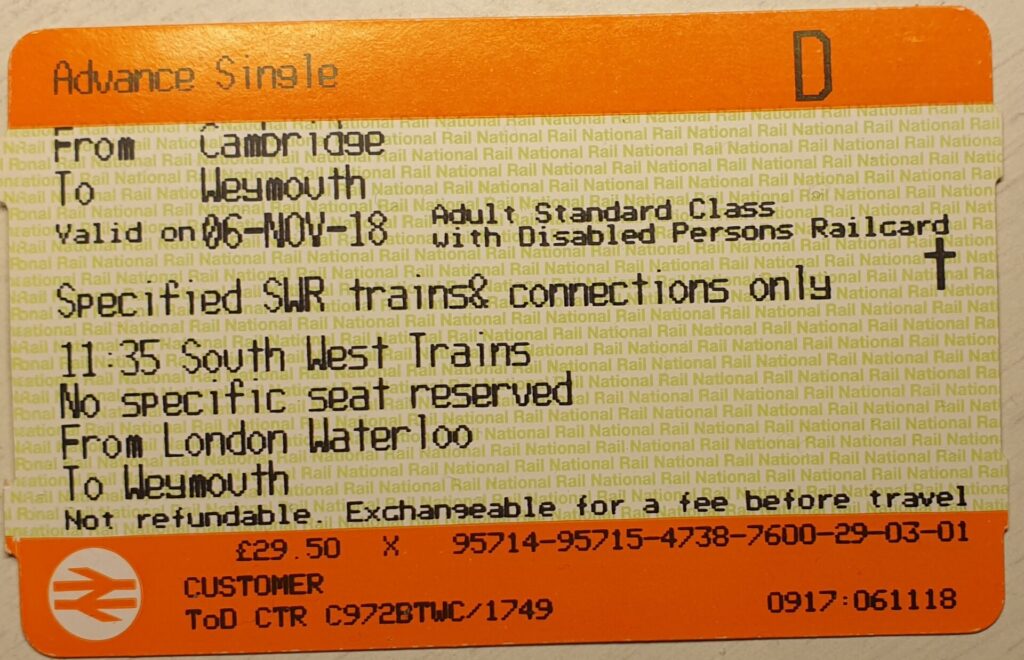
The big one. It gives a third off most rail fares — and crucially, a third off for one adult travelling with you as well. For anyone who travels with a companion or PA, that second discount is often worth more than the first.
- Costs around £20 for a year or roughly £54 for three years — check the current price when you apply.
- Works on most tickets including Advance fares, and there is no minimum fare restriction on most journeys.
- You qualify through a range of routes: receiving PIP or DLA, Attendance Allowance, Severe Disablement Allowance, being registered as visually impaired or deaf, having epilepsy treated with medication, buying or leasing a Motability vehicle, or receiving certain war pension or Armed Forces benefits.
- Apply online or by post, with evidence of the qualifying benefit or condition.
If you travel by train even a few times a year with someone else, it pays for itself almost immediately.
Free bus travel
Concessionary bus passes for disabled people exist across the UK, but the rules differ significantly by nation — which catches people out when they move or travel.
- England: the English National Concessionary Travel Scheme gives free off-peak travel on local buses — generally from 9:30am on weekdays and all day at weekends and bank holidays. Many councils add extras, such as earlier start times or companion passes. Apply through your local council.
- Wales: free travel all day, with no morning restriction, and a companion pass available for those who need one.
- Scotland: free travel all day under the National Entitlement Card, with companion provision where needed.
- Northern Ireland: the SmartPass scheme, applied for through Translink.
- London: the Freedom Pass, which is considerably more generous than the national minimum and covers the Tube, DLR and more.
Ask your council specifically about a companion or carer pass — a lot of areas offer one and very few advertise it.
Half the value in these schemes is in the companion discount, and it is the half that nobody at the ticket desk mentions.
The Access Card
Not a discount scheme, but worth knowing. The Access Card translates your needs into symbols that venues and operators recognise — “needs a companion”, “wheelchair user”, “needs assistance” — so you can prove your requirements once instead of explaining and re-proving them at every box office and station.
It carries a modest one-off cost and is widely accepted at venues, festivals and attractions for free carer tickets. For anyone who books events regularly it saves a great deal of repetitive evidence-gathering.
Blue Badge
Covered in full in our Blue Badge guide, but two reminders: it is not only for wheelchair users — hidden disabilities including autism, dementia and severe anxiety can qualify in England — and the badge belongs to the person, not the vehicle.
Community transport and Dial-a-Ride
Most areas have a community transport scheme, run by the council or a charity, using accessible minibuses with drivers trained to help. It is usually cheap or free, generally needs booking in advance, and often runs to shops, hospitals and day services.
These schemes are unglamorous and frequently the only realistic option in rural areas where the bus is a distant memory. Search your council’s website for “community transport” or “Dial-a-Ride”, or ask at your library.
Getting to work and to hospital
- Access to Work can fund taxis to work where public transport is not usable, along with equipment and support workers. It is not means-tested. See our Access to Work guide.
- Healthcare Travel Costs Scheme can refund travel to NHS appointments if you are on a qualifying benefit or low income. Ask at the hospital cashier’s office — you often have to claim on the day.
- Non-emergency patient transport is available for those whose condition means they cannot travel to hospital otherwise. Ask the department that sent your appointment letter.
Worth doing today
- Check whether you qualify for a Disabled Persons Railcard — the companion discount alone usually justifies it.
- Ring your council and ask about a bus pass and a companion pass.
- Ask about community transport in your area before you need it.
- If you are working or about to start, apply to Access to Work early; the waits can be long.